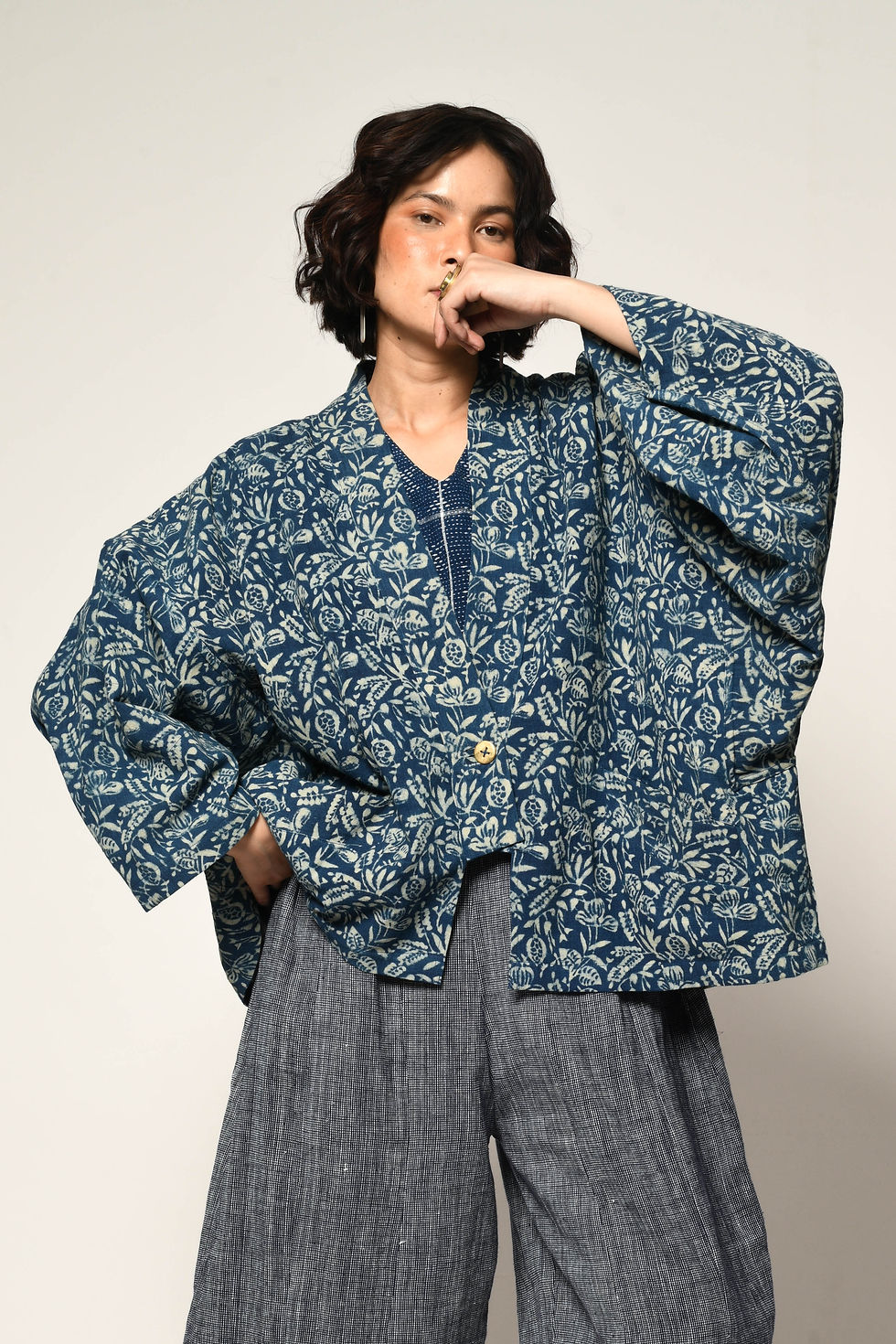
Kakumoji Cotton Hanten
Vintage Japanese kimono, selected for its textile quality, craftsmanship, and wearability. Traditionally worn as robes, these garments lend themselves naturally to contemporary dressing.
Era: Mid-late Shōwa period (c. 1950s–1980s)
Textile: Mid-weight, durable cotton canvas designed to withstand rugged labor and festival environments. The intricate multi-tonal design was achieved through Katazome (stencil dyeing), a traditional Japanese resist method utilizing hand-cut paper stencils. A thick rice-paste resist was applied to protect the pristine white and natural tan areas of the graphic before the entire fabric was immersed in a natural, deep Aizome (indigo) dye vat. The distinct vermilion accents at the top of the lapels were carefully brushed on by hand using a separate pigment stencil technique, highlighting the multi-layered artistry required for this specialized cloth. This garment is categorized as a Shirushi-banten (crested trade jacket), serving as a functional uniform, advertisement, and badge of communal pride. Historically common throughout the Meiji and Showa eras, these jackets were custom-commissioned for specific trade guilds, neighborhood fire brigades, merchants, or regional festival associations. The bold typography on the lapels indicates the specific name of the group or enterprise, while the oversized geometric blocks around the waist feature Kakumoji (square lettering) meant to make the wearer instantly identifiable within a large, crowded public event.
Silhouette & fit: This piece in one size, unstructured cut with straight-cut sleeves and a stiff drape. Designed as a one-size form that layers easily and moves across seasons and body types.
Styling: Traditionally worn as robes, these pieces can be worn open over dresses or tailored separates for everyday ease, or styled as a statement layer for evening and occasion wear. They are equally suited to display as textile art when not in use.
Condition: As vintage textiles, signs of age and wear are expected. Small stains, repairs, fading, loose stitching, or minor tears may be present and are part of each garment’s history.
All orders come lovingly packed in recycled silk bags
One size: fits S-M comfortably
Length 34"
Chest 47" round
Hip 45" round
Cross-back 25"
Sleeve length 17"
+/- a tolerance inherent to hand made clothing
Fabric: 100% cotton
Handfeel: Mid weight cotton with a stiff drape and lightly textured hand
Care: Dry cleaning recommended
Origin: Japan
Textile Story
This collection of vintage Japanese kimonos was personally sourced during a recent trip to Japan, through temple markets, antique fairs, and specialist vintage kimono dealers in Tokyo.
The selection represents a highly considered edit, informed by more than two decades spent living, studying, and working within Japanese and Indian textile cultures. Each piece was chosen not only for its wearability, but for the quality of its cloth, the integrity of its craftsmanship, and its distinctive character.
Japan occupies a special place within my own journey. At eighteen, I moved there to study, remaining for six formative years. It was during that time that I first wandered the temple flea markets and antique fairs that continue to animate Japan's collecting culture today. Among stalls piled high with old textiles, indigo workwear, baskets, ceramics, and forgotten garments, a lifelong fascination with heritage textiles quietly took root.
The kimonos gathered here reflect the extraordinary depth of Japan's textile traditions. The collection includes examples of kasuri (ikat) weaving, meisen silk, intricate shibori resist dyeing, woven patterning, hand-painted decoration, and richly coloured silk cloths. Many reveal unexpected details hidden from view - vibrant contrast linings, finely finished interiors, and small gestures of craftsmanship intended to be discovered through wear.
These garments are authentic vintage Japanese kimonos. We offer them not only as clothing, but as cultural objects and wearable textiles; preserving and extending the life of existing garments while celebrating the traditions, anonymous makers, and material histories from which they emerge.
No two pieces are alike. Each carries the marks of its own journey, embodying the quiet beauty of age, use, and careful stewardship across generations.