Jyaamiti Kantha Tussar Duster Coat | topaz
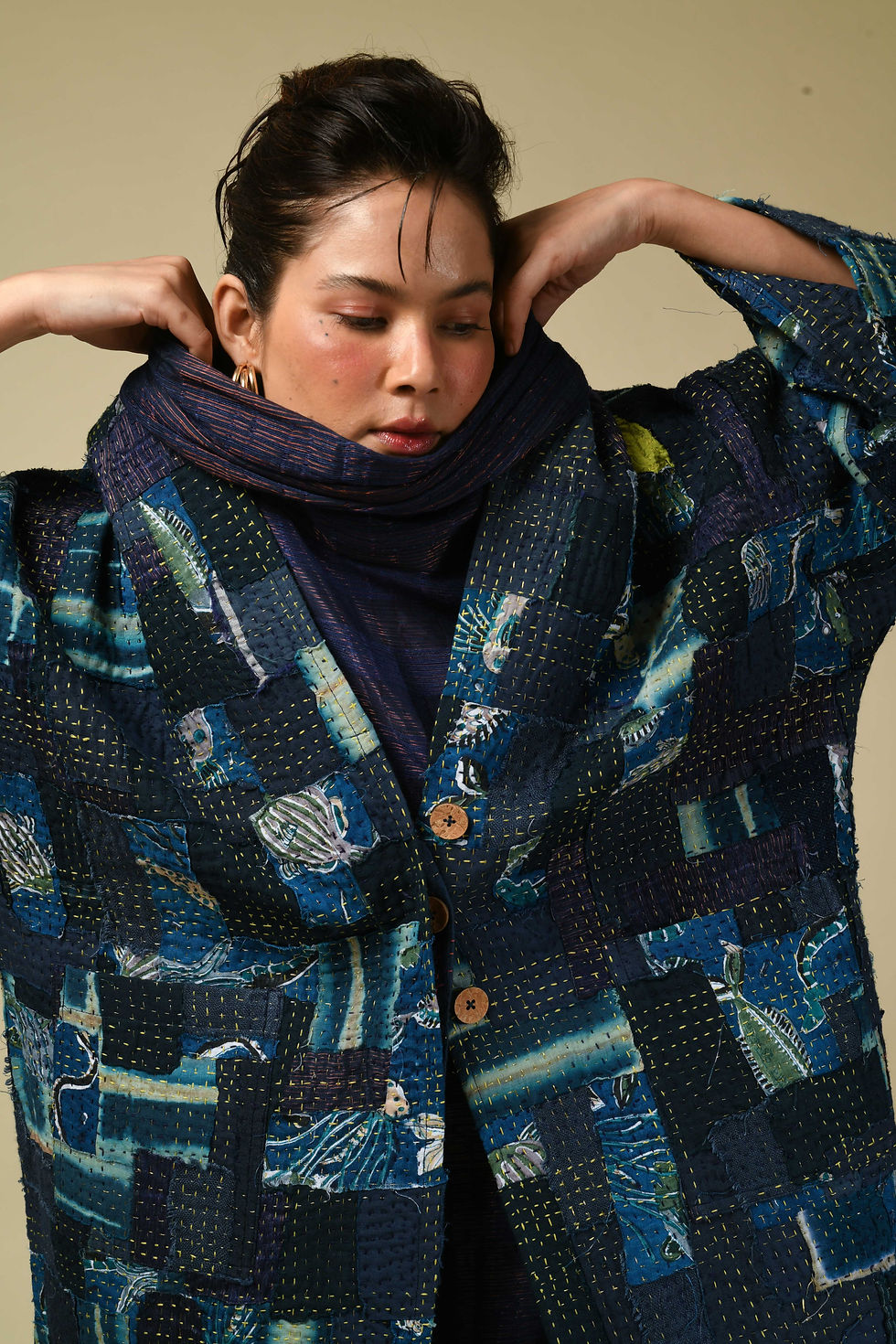
Six months in the making, this museum-worthy heirloom piece is crafted in handwoven tussar silk with the finest kantha you will ever lay your eyes upon - a veritable sampler of exquisite kantha stitches! Masters of needle & thread, our artisan partners have absolutely outdone themselves with this incredible work. We have made only a handful of these special coats, so you will own something as unique as it is stunning.
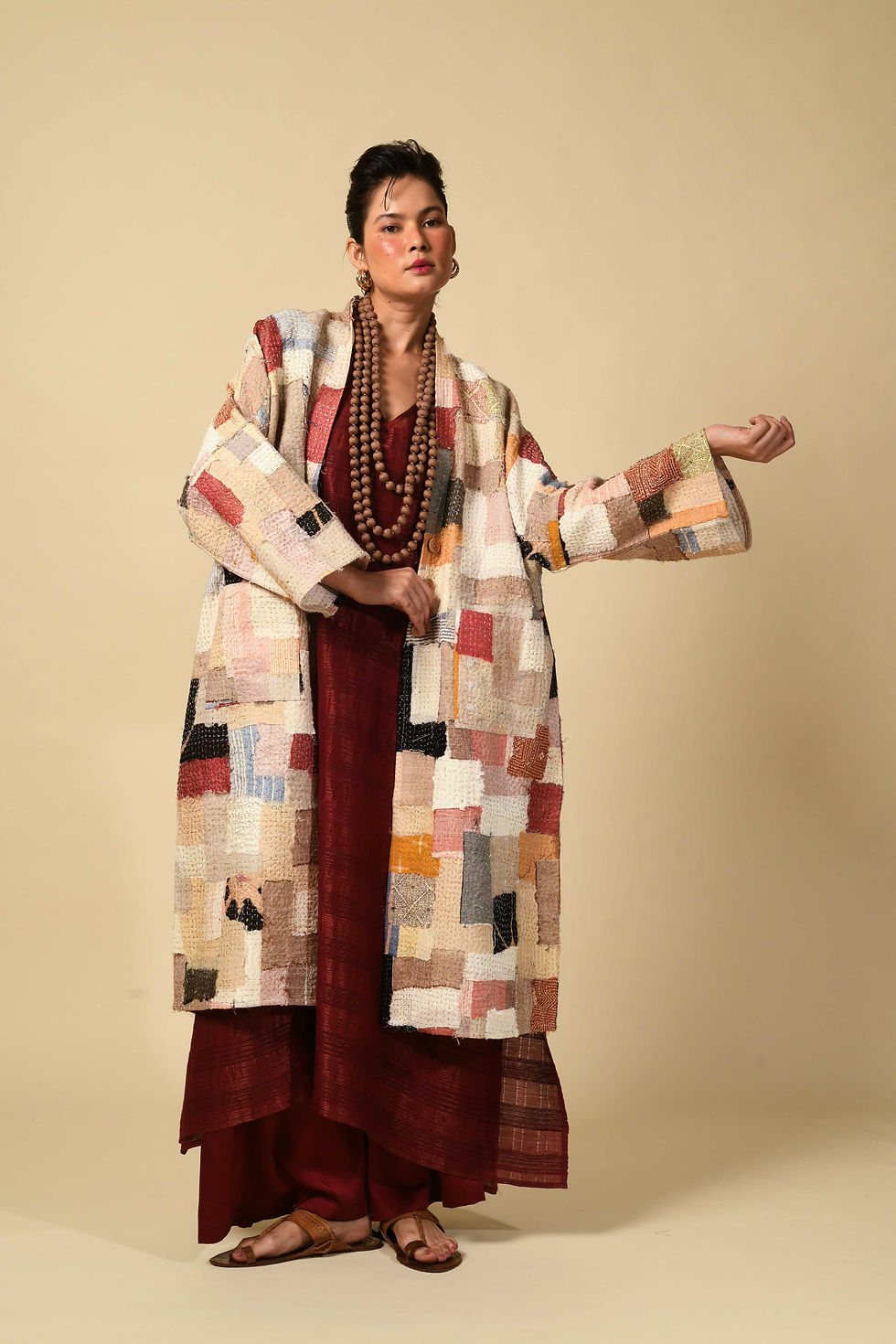
Our signature kimono silhouette-inspired Duster Coat. This piece in topaz brown tussar silk with kantha in neutral, earthen shades of ochre & clay, with highlights in golden zari.
- Wide-cut body with relaxed silhouette
- Dropped shoulders with full length sleeves that look great rolled up
- Closes down the front with hidden placket & coconut shell buttons
- Fully lined in tussar silk; the double layer of outer/inner tussar makes for a lightweight overlay
- Raised kimono-style collar
- Falls to below the knee
- Welt pockets
- Crafted in hand woven tussar silk with incredibly fine, all-over hand embroidered kantha in an engineered geometric pattern. Embroidered by female members of our WFTO-registered partner in Kolkata.
- All orders come lovingly packed in upcycled silk bags
- One size: fits S-L comfortably
- Length 40"
- Chest & hip 52” round
- Armhole 22” round & sleeve length 20”
+/- a tolerance inherent to hand made clothing
- One size: fits S-L comfortably
- Fabric: Silk
- Handfeel: Soft & lightweight; the natural crispness of the tussar has softened greatly with all the handling during embroidery.
- Care: Please care for this item by dry cleaning only
- Origin: West Bengal, India
Textile Story
Kantha is a tradition of hand embroidering patchwork cloth from rags. Over time it evolved from a simple running stitch into a rich & varied embroidery language, depicting motifs influenced by religion, culture & the rural lives of the women stitching them. Deeply rooted in Bengal & with a history of over 3,000 years, kantha is rich in story & meaning.
After working for over a decade with this artform, we wanted to elevate the craft through the use of highly engineered stitch placement, exploring the wide range of stitches existing within the kantha lexicon. In partnership with textile designer, Brinda Dudat, we took a year to design the patterns, and together with our artisan partners in Kolkata, experiment with cloth and colour.
Once the pattern is finalised, it is copied onto tracing paper. Next, the lines of the pattern are punctured by hand with a pin and the paper is then laid over the silk fabric. A paste of chalk and turpentine is rubbed over the paper, and seeps through the small pin-holes onto the fabric below.
Now the silk has the pattern lines traced onto it. It's ironed and distributed amongst the artisans - only the most experienced and skilled women can stitch these - who take it home and stitch the kantha, following a blueprint outlining which stitch and colour is to be used where. Once complete, the fabric is hand washed several times to remove any stains and the tracing lines.
Whether it be a plain stitch on patched rags, or highly illustrative embroidery on the finest silk, this humble art form is created today as it has been for centuries: in small, unassuming village homes by women who spend days, weeks & even months on one piece.
Any variations or irregularities are to be celebrated. They are part of the design & inherent to the handcrafted production process, making this item beautifully unique.