

A Japanese Movement Changed the Way I See Indian Cloth
Updated: Aug 31
The Mingei Movement changed the way I see Indian cloth.
Over many years of living and working in Japan and India, my appreciation of cloth has been shaped by two distinct textile cultures. The discovery of the Japanese Mingei Movement gave me a new language to articulate the beauty I had long recognised in India’s handmade traditions.
I first encountered Mingei during my years living in Japan in the early 2000s, where I became fascinated by a philosophy that looked beyond decoration and rarity to find beauty in everyday objects shaped by use, material and generational knowledge. Closely associated with Japan's broader appreciation of simplicity, imperfection and natural materials, it offered a way of seeing that stayed with me long after I left Japan. It was only years later, after building my work with Indian textiles, that I began to understand how deeply this philosophy connected with what I was seeing in India: cloth shaped by place, community and inherited knowledge.

Yanagi Sōetsu and Japan’s Mingei Movement
Yanagi Sōetsu, together with the potters Hamada Shōji and Kawai Kanjirō, developed the concept of mingei (民藝) - literally "the crafts of the people," from min (民, people) and gei (藝, craft or art) - in the 1920s, during a period when rapid industrialisation was transforming Japan's relationship with handmade objects. Deeply influenced by Buddhist thought, Yanagi saw beauty not simply as an aesthetic quality, but as something that could emerge naturally through humility, honest making and everyday use. The term was formally introduced in 1925, and the movement gained momentum with the establishment of the Japan Folk Crafts Museum (Nihon Mingeikan) in Tokyo in 1936.

At a time when mass production increasingly valued efficiency and uniformity, Yanagi turned his attention towards everyday objects created within traditional craft communities: ceramics, textiles, baskets, tools and household objects made by anonymous artisans rather than recognised artists. He believed that these objects possessed a particular kind of beauty; one that emerged through practical use, honest materials and the accumulated knowledge of generations.
For Yanagi, their value did not lie in rarity or individual authorship, but in the relationship between maker, material and community. Their forms had evolved over time through necessity and experience, creating objects that were functional, enduring and deeply connected to everyday life.
Yanagi Sōetsu - his ideas were collected in a series of essays, “The Beauty of Everyday Things,” published in 1926
A New Language for Indian Cloth
Reading through Sōetsu Yanagi’s essays and visiting the Nihon Mingeikan in Tokyo deepened my understanding of this philosophy. Mingei offered a different way of seeing: a seemingly simple handmade object could represent generations of refinement, an intimate understanding of material, and knowledge developed through countless hours of making.
Indian textiles are often celebrated for their visible expressions of craftsmanship - the complexity of their techniques, the intricacy of their patterns, the richness of their colours and the labour involved in elaborate embroidery or weaving. These traditions are extraordinary. Yet the Mingei perspective asks us to recognise another form of mastery: the knowledge contained within objects whose beauty is quieter and less immediately apparent.
Khadi is a powerful example. At first glance, hand-spun cotton may appear plain compared to India’s more elaborate textile traditions. Yet within its simplicity lies a profound understanding of material. The artisan must understand the nature of the fibre, the behaviour of the yarn, the effect of season and weather on the materials and tools, the tension of the loom, and the subtle variations created through hand-spinning and handweaving. These skills are not simple; they represent years of practice, patience and accumulated knowledge.

For Mingei, the value of a handmade textile is not determined only by ornamentation or complexity, but by the relationship between maker and material - the ability of a skilled artisan to reveal the inherent qualities of the fibre and transform it into cloth. A fine khadi will preserve the best natural characteristics of the cotton bole: softness, breathability and absorbency.
Gandhi recognised the social and political significance of khadi, transforming hand-spun cotton into a symbol of self-reliance, dignity and independence. Yet beyond its symbolism, khadi also embodies the qualities that Mingei sought to celebrate: the texture of hand-spun yarn, the variations of handwoven cloth and the visible evidence of the maker’s process.
This is where Mingei and Indian textile traditions meet. They emerged from different historical circumstances - one as an aesthetic philosophy responding to industrialisation, the other as a movement for social and political transformation - but both recognised that handmade cloth was never merely a commodity. It carried knowledge, identity and belonging.
By the time I explored the Mingei movement more deeply, I had already spent years working with India’s handmade textile traditions. Travelling across the country and collaborating directly with artisans reinforced the idea that cloth carries far more than the labour involved in its making. The Mingei perspective gave me a new language for articulating what had always drawn me to these textiles: their beauty lies not only in how they are made, but in the histories, skills and communities they carry.
OBJECT 01 Handwoven Kasuri Double Ikat Nehru Dress
The People Behind the Cloth
One of the most powerful ideas I took from Mingei was a different understanding of authorship.
A handmade textile is not simply the expression of one maker; it is the result of a chain of knowledge passed between generations. The beauty of anonymous making lies not in the absence of the maker, but in the presence of a wider cultural memory.
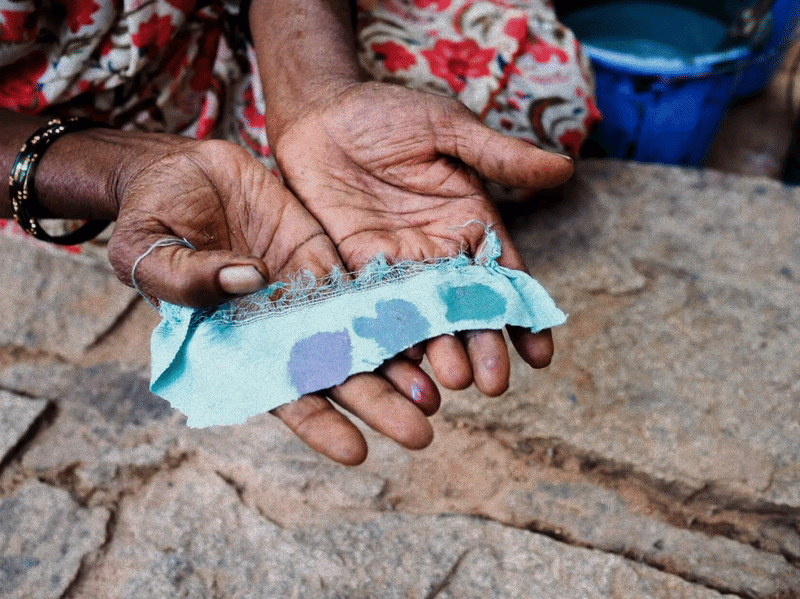
The cottons in The Mingei Collection begin long before the loom. They involve farmers who cultivate the fibre, spinners who transform it into yarn, weavers who understand the rhythm of the loom, and dyers who bring colour through inherited knowledge. The slight irregularities in the yarn, the texture created by hand-spinning, and the variations of natural dyes are not imperfections to be removed. They are evidence of a living process: a piece of handwoven cloth carries more than its material qualities. It carries the landscape where it was grown, the hands that transformed it, and the communities that have sustained its making.
In an increasingly digital world, the Mingei perspective offers a reminder to slow down and look more closely. Handmade textiles ask us to recognise forms of knowledge that cannot be automated: the understanding of a fibre, the rhythm of a loom, the judgement developed through generations of practice. Their value lies not in resisting change, but in preserving the human relationships and material intelligence that give objects meaning.
This is perhaps the quiet beauty that Mingei helped me articulate: that ordinary cloth can carry extraordinary histories.

THE MINGEI COTTON COLLECTION
Memory. Utility. Restraint.
The collection translates these ideas into cloth: handspun and handwoven cotton, indigo, jamdani, ikat and other Indian textile traditions, shaped into an understated wardrobe for everyday use.
The Origin of the Word Mingei - Soetsu Yanagi, 1933
The Japanese word for "folk craft" or "folk art," mingei, is relatively new. It is often confused with tribal art, peasant art, or the broader arts of the common people. In coining this term, Shoji Hamada, Kanjiro Kawai, and I sought clarity. We combined "min," meaning "the masses," with "gei," meaning "craft," creating the term mingei. Literally, this means "crafts of the people." It contrasts with aristocratic fine arts and signifies objects used by ordinary people in their daily lives, such as clothing, furniture, and tools.
Folk craft objects share two main features. First, they are made for daily use. Second, they are ordinary and accessible, not costly or produced in limited quantities. Their creators are anonymous artisans, not renowned artists. These crafts are designed for practical use, not just for aesthetic pleasure.
Essential to this concept is the object’s ability to fulfill its practical purpose. This requires careful material selection, methods appropriate to the craft, and meticulous attention to detail.
Thus, folk craft is dedicated to practical purposes. It becomes a trusted companion in our daily lives, evolving into a familiar part of our routines. However, it’s important that these crafts maintain their integrity: they should not be poorly made or overly ornate. Instead, the focus is on sincere, functional craftsmanship. The beauty of folk art lies in its wholesome and natural attributes, born from a commitment to utilitarian needs.
Further Reading
The Unknown Craftsman, Yanagi Sōetsu, 1972
The essential introduction to Yanagi's philosophy and the Mingei movement.
The Beauty of Everyday Things,Yanagi Sōetsu, 2019 (English compilation of translated essays)
A beautifully accessible collection of Yanagi's essays exploring the relationship between beauty, utility and everyday life.
Khadi: India's Fabric of Freedom, Martand Singh, 2002
A richly illustrated exploration of khadi as both a symbol of India’s independence movement and a living textile tradition shaped by hand-spinning, weaving and the communities who sustain it.
Places to Visit
The Japan Folk Crafts Museum (Nihon Mingeikan), Tokyo, Japan
Founded by Yanagi Sōetsu in 1936, this is the heart of the Mingei movement. Its collection presents ceramics, textiles, woodwork and everyday objects as expressions of material knowledge, regional tradition and human skill.
Bingoya (備後屋), Tokyo, Japan
A remarkable folk craft shop in Tokyo specialising in handmade objects from across Japan. Founded in 1962, it carries textiles, ceramics, lacquerware, woodwork and everyday objects selected according to the Mingei philosophy - objects made to be used, not simply admired.
Kurashiki Folkcraft Museum, Okayama, Japan
One of Japan’s most important regional Mingei museums, housed in traditional kura warehouses in the historic town of Kurashiki. It offers a deeper understanding of how folk craft traditions developed within local communities.
Sabarmati Ashram, Ahmedabad, India
Gandhi’s former home and the centre of the khadi movement, where hand-spun cloth became a symbol of self-reliance, dignity and independence.
Calico Museum of Textiles, Ahmedabad, India
A remarkable collection exploring the depth of India’s textile heritage, revealing how fibres, techniques and regional traditions have been transformed into cloth carrying histories of place, community and cultural knowledge.
Kutch District, Gujarat, India
A living textile landscape where communities continue traditions of weaving, resist dyeing, embroidery and natural dyeing within their original cultural context.


For anyone exploring LPB Piso WiFi 10.0.0.1 pause time login, it is important to verify the correct gateway address first. The login process may vary depending on the router configuration and network provider.